Chats forget.
A model's memory is a whiteboard wiped at the end of the session. Decisions, preferences, facts — gone by tomorrow, unless someone rebuilds them by hand.
Durable memory for AI agents
Remembero reads what you say and turns it into knowledge — facts with their source sentences, dated and kept current when things change, rules that derive what follows — and answers with the proof attached. You just watched it happen: raw sentence in, extracted facts, proven answer out.
This whole site runs in your browser. No accounts, no installs — and none of our model weights anywhere.“I moved my Chicago flight to Saturday morning — the Friday 6pm one was killing me. And I'm at the Marriott downtown now, not the airport Holiday Inn.”
flight(chicago, saturday_morning)“moved my Chicago flight to Saturday morning”hotel(chicago, marriott_downtown)“at the Marriott downtown now, not the airport Holiday Inn”When do I fly to Chicago?
the machine seesflight(chicago, When)Saturday morning.
01 · The problem
If you have ever asked an assistant about something from last month and gotten a confident invention, you already know all three of these.
A model's memory is a whiteboard wiped at the end of the session. Decisions, preferences, facts — gone by tomorrow, unless someone rebuilds them by hand.
The usual fix searches old text for passages similar to the question. Similar is not relevant: it grabs what is nearby, cannot combine facts across sessions, and cannot say what it missed.
When memory half-remembers, agents answer anyway. The failure is silent — no missing-piece alarm, no audit trail, no way to check the working after the fact.
02 · The idea
Facts are short, plain sentences with their source attached — readable by you, and exact enough for a machine.
“Dana and you meet on Tuesdays” — said 3 JunRules are plain if-then knowledge: a meeting with your manager is a one-on-one. Written once, applied forever, same result every time.
if someone is your manager and you meet, that meeting is a 1:1Questions become queries over facts and rules. Every answer carries the chain of evidence behind it — or an honest “not in memory.”
answer + the facts and rule behind itNo model did any of this. That is the point — and the demo on the right is doing it for real, in your browser, as you click.
“Dana is my manager.”
1:1 planning · 3 Jun
“We meet on Tuesdays.”
1:1 planning · 3 Jun
Plain facts, each with the sentence it came from.
Reads as: a meeting with your manager is a one-on-one.
“Do I have a 1:1 this week?”
03 · The same idea, deeper
Real updates don't arrive as tidy facts — they arrive as a paragraph that states things, hides dates in phrases like “the end of this month,” implies arithmetic, and announces changes. Take this one apart a layer at a time.
Team update, 14 March — quick heads-up. I'm stepping back from the Orion rollout at the end of this month; Nadia takes it over from April. We moved the launch two weeks out, so it's now the 28th, not the 14th. Budget-wise we're at $48k of the $60k cap; if the vendor renews at the old rate we'll exceed it by roughly $5k.
one chat message · said 2026-03-14
rollout_lead(orion, you)“I'm stepping back from the Orion rollout at the end of this month”rollout_lead(orion, nadia)“Nadia takes it over from April”launch_date(orion, 2026-03-28)“We moved the launch two weeks out, so it's now the 28th, not the 14th”budget(orion, $48k of $60k)“we're at $48k of the $60k cap”exceeds_cap(orion) :- renews_at(orion, old_rate).“if the vendor renews at the old rate we'll exceed it by roughly $5k”The writer reads English so the rest of the system never has to. A sentence becomes a claim that carries its own source.
Each layer is the same move — text becomes knowledge you can query — with more machinery behind it. The labs take the layers further: the writer–reader lab runs this on six months of messy history.
04 · Try it
Work deeper at each step. Everything runs in this tab over fictional data — and wherever a model appears, it is either an open model your own browser loads on demand, or a clearly labeled replay of a recorded run.
Six months of messy chat — corrections, a switch-back at a new price, a handover, a contract that ends, and one question never answered anywhere. Watch the writer turn it into claims, watch code build validity timelines, then ask what breaks naive memory.
A language model answers questions by calling Remembero as a tool over one shared database — against raw SQL in the other lane, so you can see exactly what the structure buys.
A model proposes an action it must never own — and a deterministic gate approves or blocks it, with the complete decision proof on screen.
The reading pipeline, assembled step by step: which chats get picked, which get condensed, and the date-and-arithmetic notes code writes before any model reads — then both sides of a recorded before/after run.
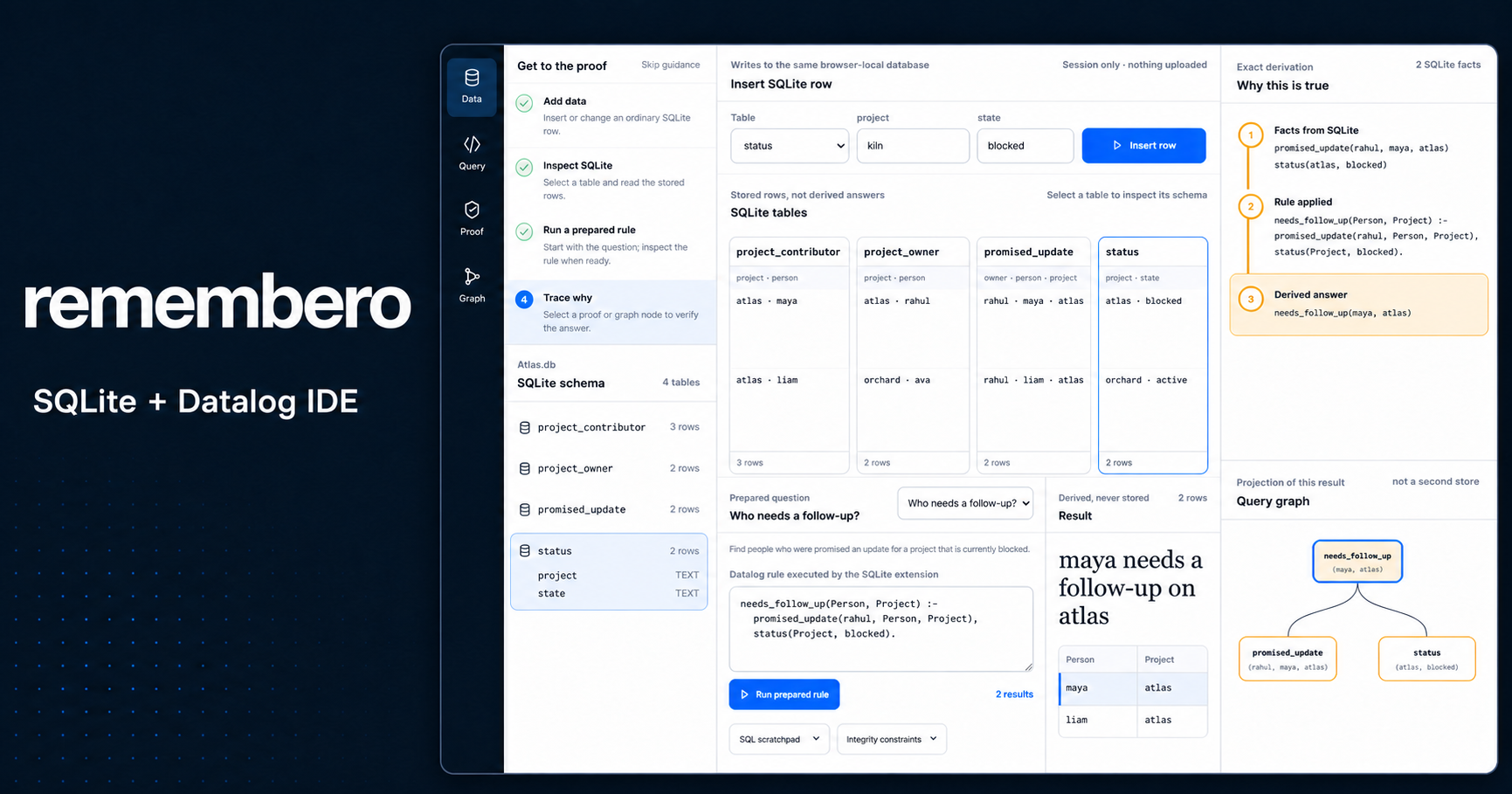
05 · The evidence
Remembero's claim — that structure beats scale for agent memory — is tested, not asserted. On a public benchmark of 500 questions about long chat histories, a small open model kept getting more right as deterministic code took over the parts models are bad at. It now sits fifteen questions behind the frontier model that trained it.
06 · Where models fit
Everything you tried above ran with zero models. When you want to speak plain English to your memory, a model does the translating — an open model loaded by your own browser in the labs, or any API model in the real product. The model never decides what is true. The rules do, and they show their work.
07 · Start building
remembero init installs the Claude Code hooks and a session brief.npx -y rememberoStart with the sixty-second demo, work a lab, then open the database itself — the whole ladder is one click away.